
As Indigenous people in Peru harvest stories of their past tied to the rubber industry, governments and corporations find that history isn’t easy to erase.
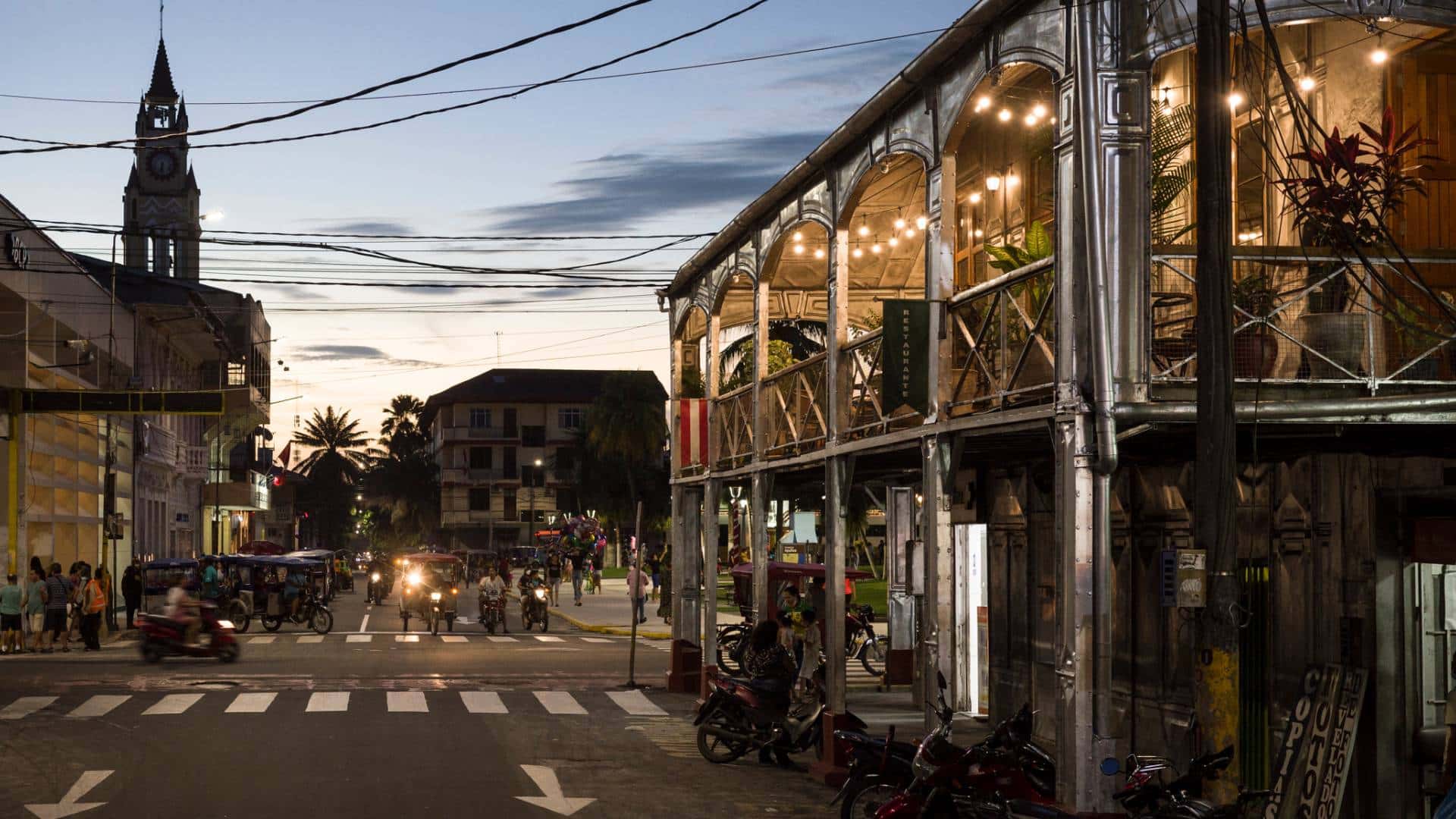
The Iron House or Casa de Fierro in Iquitos, bought in Paris and reassembled by a rubber baron in 1890. (Photo
by Alfonso Silva-Santisteban)
This article was produced exclusively for News Decoder’s global news service. It is through articles like this that News Decoder strives to provide context to complex global events and issues and teach global awareness through the lens of journalism. Learn how you can incorporate our resources and services into your classroom or educational program.
How many of the most useful substances in the world carry a history of violence? Think rubber. Think tires, shoes, gloves, erasers and hundreds of other everyday products. How often does a rubber band come in handy?
In Peru, however, “el caucho”, as it is known, is linked to more than a century of exploitation of Indigenous people and neglect by the governments to include that history as part of public education and memory.
In August, a lawsuit filed by Tsiuni, a collective of Amazonian Indigenous young people, will get its first hearing. Tsiuni is demanding that Peru establish a truth commission to investigate crimes inflicted on the country’s Indigenous people by the rubber industry. Only when the truth comes out, they believe, will historical wounds heal.
“When the state apologizes,” said Omar Navarro, 19, with a soft voice that contrasts the firmness of his ideas. “The state was complicit in all of this.”
After Charles Goodyear discovered and mastered vulcanization in 1839, rubber became one of the world’s most coveted commodities. The elastic, resistant substance is formed by mixing sulfur with rubber tapped from the Hevea tree of the Amazon.
The Rubber barons
Toward the end of the 19th century and the beginning of the 20th, the rubber industry in the Amazon rainforest exploded.
In Peru, Casa Arana, a company built by Julio César Arana and later renamed the Peruvian Amazon Company, came to be listed on the London Stock Exchange, the most important in the world at the time.
Iquitos, the town on the banks of the Amazon River from which Peruvian rubber was exported, became a city of mansions built by the so-called “rubber barons” with Parisian architecture and Spanish tiles, steamships, a railway and gala clothing worn by the new tycoons.
One such baron even went so far as to buy a building made entirely of iron at the International Exposition of Paris in 1889 and had it dismantled, the pieces shipped and carried over land by laborers and rebuilt in Iquitos. It is now a major tourist attraction, known as the Casa del Fierro or House of Iron.
The official history presented the rubber barons as pioneers who brought development and wealth to an inhospitable place. Two decades later, reports documented the murder, rape, torture and exploitation of thousands of Indigenous people on plantations along the rivers of the Putumayo basin.
It is estimated that those practices wiped out 90% of the Indigenous population in the area and displaced thousands of people.
Even so, the exploitation continued. To defend it, the press and politicians portrayed the barons as civilizers of “savage Indians” and defenders of national sovereignty.
Only when the rubber production in Southeast Asia displaced Amazonian production did the rush come to an end. The Peruvian Amazon Company declared bankruptcy in 1913, and in the following decades Iquitos became one of the most isolated cities in the country, still longing for the boom years that left behind a legacy of violence and discrimination.
Rubber baron Julio César Arana went on to become a senator for Iquitos. The perpetrators faced no repercussions.
Unburying the past
Navarro was born in Iquitos and is the president of the Tsiuni Collective. He studies anthropology and holds three jobs: as an assistant at the Amazonian Library Archive, at the hostel where he rents a room and the Catholic Church Offices in Iquitos.
He was 16 when a school assignment led him to ask his grandparents about his family’s history. It was only then that he discovered he was Indigenous, and that his Kukama and Quechua-Lamas roots are tied to stories of exploitation and to the Marañón and Ucayali rivers which, just as when they merge to form the Amazon, intertwine to define who he is.
Livia Silvano, a 25-year-old filmmaker who co-directs an international Amazonian film festival called Muyuna Fest, said this belated discovery of Indigenous history is common. “They don’t tell us that Iquitos was built on top of that history,” Silvano said. “We’re only told the pretty parts.”
This year, Muyuna Fest focused on the memory of el caucho in support of the Tsiuni Collective. “To plant a doubt and an awakening,” she said.
Born in Belén, a neighborhood of Indigenous migrants in Iquitos, she only recognized her own Kukama roots two years ago. The land in Belén belonged to the Arana family until the 1970s, when it was expropriated by the state. This year’s festival ran the play Monólogos del Caucho (Rubber Monologues) which told the story of the rubber boom from a current perspective.
Contemporary forms of exploitation
“This land never found peace again,” said actress Marina Díaz, draped in a black tunic and holding an oil lamp, opening a scene from the play staged in one of the first mansions built in Iquitos.
The line reads like an analysis of the present. Today, extractive activities such as drug trafficking, gold mining and illegal logging pose an existential threat to the Amazon region, through structures ranging from informal micro-extraction to transnational organized crime.
In Peru, illegal gold mining generates more money than drug trafficking, around $10 billion a year, and contaminates rivers with mercury. A 2025 study by the Amazonian Scientific Innovation Center found blood mercury levels up to 25 times higher than the limit set by the World Health Organization among residents of the Peruvian section of the Putumayo, the epicenter of rubber extraction during the boom.
During one of the festival’s screenings, a girl approached Alexis Grefa, a communicator and leader of Ecuador’s Kichwa (or Quechua) people, and pointed at one of his earrings. “Are those feathers?” she asked. “Yes,” Grefa replied. “Are you Indigenous?” she asked. “Yes, and you?” “No!” said the girl, so bluntly that it left him taken aback.
Even today, many people associate being Indigenous with something negative and are unaware of their own origins. “They call you ‘indio’ if you look unkempt or if you’re not working or studying,” Silvano said.
“People still carry the memory of mistreatment, discrimination and constant insults,” says Luis Gonzales Polar, a popular educator in the Amazon who has worked with children and teenagers for three decades.
She is working to change that attitude. “We’re seeing people arrive from different places, wearing different clothing, proud of their roots,” she said.
Personal history
Navarro now knows the stories of his family. His maternal great-grandmother, of the Quechua-Lamas people, handed her 12-year-old daughter over to a visitor so she could study in the city.
It was part of a practice known as padrinazgo, in which outsiders lured Indigenous children and young people with false promises, to then offer them up as free or poorly paid labor in the cities. She settled at Juancito, a small town on the banks of the Ucayali River.
His father’s family are from the Kukama people. They came to the northwestern Peruvian rainforest from Brazil and settled in Nueva Esperanza, a community on the banks of the Marañón River. His great-grandfather worked a rubber-tapping plot.
He would leave home for months at a time and return with little money, or in debt, with whip marks on his body. The boss docked his pay if he failed to meet quotas and forced him to buy food at his own stores.
“Rubber extraction ended in the Putumayo in the 1920s, but it continued in other areas,” Navarro said.
The power of language
Navarro’s paternal grandfather migrated to Iquitos as a teenager. Before he left for the city, his father advised him to forget his roots and stop speaking Kukama, which he called “the devil’s language.” He settled in the Belén neighborhood, where he met Navarro’s grandmother.
When, at the Muyuna Fest, 22-year-old Marisol Díaz Acama watched a Brazilian documentary “Secrets of the Putumayo,” about British Crown envoy Roger Casement, who in 1911, documented the murder, rape, torture and exploitation of thousands of Indigenous people on plantations along the rivers of the Putumayo basin, she was left speechless.
She hadn’t known that part of the history of Amazonian peoples and couldn’t understand why Indigenous people hadn’t rebelled.
Díaz Acama is from Ecuador, where the Indigenous Amazonian movement has a decades-long tradition of mobilization and is a national political force. She is Kichwa and works with the organization Pakkiru to preserve her people’s customs and traditions.
The Tsiuni Collective — tsiuni means “to listen” in the Kukama language — was founded in 2025 following a gathering of Indigenous peoples organized by Radio Ucamara, an organization with decades of community work on memory and Indigenous identity.
Shared stories
At the gathering, Navarro heard the stories of the grandparents and great-grandparents of young people like himself and grasped the true scale of the atrocities committed during the rubber boom, which he had never heard about in school.
“The stories are alive in the territory,” Navarro said.
It was the discovery of his own family history that led Navarro to study anthropology and shaped his political activism. He has the confluence of the Marañón and Ucayali rivers tattooed on his left arm.
Tsiuni is made up of 46 people, most of them young people from different Indigenous groups. Several are university students seeking to give their organization political influence.
After the gathering, two lawyers suggested they sue the state, demanding a truth commission whose findings could become part of the school curriculum.
“We have to talk about el caucho, because the wounds are still open,” Navarro said.
Calling on the law
They filed the lawsuit against the Peruvian State in October 2025. A first hearing is set for August. The process could take years. Gonzales Polar sees it as a matter of reparation and symbolic justice that has partially happened in neighboring countries.
In 2012 for example, Colombian President Juan Manuel Santos apologized on behalf of the state to the Murui-Muinane, Bora and Okaina peoples, victims of a genocide a century earlier in what is now Colombian territory.
Young people like Navarro, Silvano and the members of Tsiuni are part of a movement seeking to problematize — or submit to critical analysis something long accepted — an era that left behind a legacy of violence, forced migration, concealment and the normalization of discrimination against an identity they now claim with pride.
That, perhaps, is what sets them apart from the academics and civil society organizations that have worked on this issue for years and called for an official reckoning with the facts. They embody history.
“The struggle is part of me,” Navarro said. “I do it for my grandfather, I do it for my family.”
Questions to consider:
1. Why do you think people were able to make so much money from rubber?
2. What has replaced rubber as a product produced and exported from Peru?
3. Why do you think people in many countries have so little control over the natural resources in their own regions?

Alfonso Silva-Santisteban is a physician and independent journalist based in Lima. He has over 15 years of research experience in subject areas around human rights, LGBTQ+ minorities and HIV&AIDS prevention. He is a graduate of Global Journalism Fellowship at the Dalla Lana School of Public Health, University of Toronto and a researcher at the Centre of Interdisciplinary Research on Sexuality, HIV&AIDS and Society at the Universidad Peruana Cayetano Heredia.